
Small Business Flood Preparedness: A Complete Guide to Protecting Your Operations During Flood Season

A flood watch notification can mean very different things depending on how prepared your business is. For some owners, it triggers a scramble to close early and hope for the best. For others, it's simply a signal to execute a plan they've already put in place.
The difference between these two scenarios often comes down to preparation—not luck.
This guide covers what small business owners actually need to know about flood preparedness: understanding the risks, protecting your physical space, maintaining operations safely, and recovering quickly if water does get in. Whether you're in a coastal flood zone or an area experiencing increasingly unpredictable weather patterns, these strategies can help you protect both your property and your livelihood.
Understanding Flood Risk for Small Businesses
Flooding represents one of the most financially devastating natural disasters for small businesses, yet it's also one of the most manageable with proper planning.
The Real Cost of Flooding
The Federal Emergency Management Agency (FEMA) reports that flooding is the most common and costly natural disaster in the United States [1]. For businesses, the damage extends well beyond the obvious water cleanup:
Direct costs include:
Structural damage to floors, walls, and foundations
Destroyed inventory and equipment
Electrical system repairs or replacement
Mold remediation (which can begin within 24–48 hours of water exposure)
Indirect costs often overlooked:
Lost revenue during closure
Employee wages during downtime
Customer relationships that shift to competitors
Supply chain disruptions
Increased insurance premiums
According to FEMA, businesses that experience a major disaster and don't have a continuity plan often struggle to reopen [2]. The businesses that do recover typically share one characteristic: they planned ahead.

Flood Watch vs. Flood Warning: Know the Difference
Understanding National Weather Service terminology helps you respond appropriately:
Flood Watch: Conditions are favorable for flooding. This is your preparation window—typically issued hours or even days before potential flooding occurs [3].
Flood Warning: Flooding is imminent or already occurring. At this point, your preparation should already be complete, and your focus shifts to safety.
Flash Flood Warning: The most urgent alert. Flash flooding is happening or will happen very soon. Immediate action is required.
The critical point: a flood watch is not a signal to panic—it's a signal to prepare. Most flood watches don't result in catastrophic flooding, but they should trigger your preparation checklist.
Physical Flood Protection for Your Business
Protecting your physical space requires understanding where water enters and how to prevent or minimize that entry.
Identifying Vulnerable Entry Points
Water intrusion typically occurs at predictable locations. Walk through your space and examine:
Door thresholds: Check the bottom inch of every exterior door. Visible daylight or noticeable drafts indicate gaps where water will enter.
Loading dock doors: These often have larger gaps due to heavy use and are frequently at or below street level.
Basement or ground-level windows: Any window at or near grade level is a potential entry point.
HVAC vents near ground level: Often overlooked, these can allow significant water entry.
Garage-style roll-up doors: The bottom seals on these doors wear unevenly and create gaps.
Utility penetrations: Where pipes, cables, or conduits enter the building.
Document each vulnerable point. This becomes your action checklist when a flood watch is issued.
Waterproofing Solutions: Comparing Your Options
Multiple approaches exist for protecting entry points, each with distinct advantages and limitations:
Sandbags
Advantages: Widely available (sometimes free from municipalities), can be stacked to significant heights, familiar to most people
Limitations: Heavy (40–50 lbs each when filled), require advance procurement, messy to deploy and dispose of, redirect water rather than creating a true seal, contaminated after use
Best for: Diverting water flow away from entrances, creating barriers in outdoor areas
Water-Activated Barriers (Quick Dam style)
Advantages: Lightweight when dry, expand automatically with water contact, no sand required
Limitations: Single-use, become very heavy once activated, typically block only 3–4 inches of water per barrier
Best for: Supplemental protection, areas where sandbag storage isn't practical
Adhesive Barrier Tape
Advantages: Creates direct seal at entry points, lightweight, applies quickly without tools, stores easily
Limitations: Works best on clean, dry surfaces; temporary solution; effectiveness depends on proper application
Best for: Sealing doors, windows, and gaps; situations requiring rapid deployment
Removable Flood Barriers/Panels
Advantages: Reusable, can protect larger openings, professional appearance
Limitations: Expensive, requires advance installation of mounting hardware, may need multiple people to deploy
Best for: Businesses with recurring flood risk and budget for permanent infrastructure
Sump Pumps
Advantages: Actively removes water that enters, works continuously
Limitations: Requires electricity (consider battery backup), only effective once water is already inside, needs regular maintenance
Best for: Basements and below-grade spaces, backup protection
For most small businesses, a combination of methods provides the best protection. Adhesive barriers seal entry points while sandbags or water-activated barriers provide secondary defense.
Sealing Entry Points: A Practical Approach
When a flood watch is issued and you need to seal entry points quickly, adhesive barrier products offer significant advantages for small business applications.
FloodTape® is one option designed specifically for this purpose—an 8-inch wide adhesive barrier that creates a seal around doors, windows, and other openings. Unlike sandbags that redirect water or conventional tape that leaves residue and damages surfaces, products like FloodTape® are engineered to seal gaps while removing cleanly afterward [4].
Application basics for adhesive barriers:
Clean the surface: Wipe down door frames and thresholds to remove dust and moisture. Adhesive bonds best to clean, dry surfaces.
Measure your needs: A standard commercial door typically requires 15–18 feet of material to seal the bottom and sides. Plan for all entry points you've identified.
Apply from inside: Working from inside your building gives you better control and keeps you out of rising water.
Overlap sections: Where pieces meet, overlap by at least one inch to maintain seal integrity.
Check all entry points: Don't forget basement windows, side doors, and ground-level vents.
The entire process typically takes 15–30 minutes for a primary entrance—significantly faster than sandbag deployment and without the heavy lifting or disposal concerns.
Business Continuity During Flood Events
Protecting your physical space is only part of flood preparedness. Maintaining business operations—or recovering them quickly—requires broader planning.

Before the Flood Watch: Year-Round Preparation
Inventory and equipment protection:
Install shelving that keeps inventory at least 12 inches off the floor
Identify which equipment can be quickly elevated or relocated
Keep plastic bins or waterproof containers on hand for rapid inventory protection
Document all inventory with photos for insurance purposes
Digital preparedness:
Maintain cloud backups of all critical business data
Ensure you can access key systems remotely
Keep digital copies of insurance policies, vendor contacts, and employee information accessible from anywhere
Test your backup systems regularly
Insurance review:
Standard business insurance typically does not cover flood damage
The National Flood Insurance Program (NFIP) offers flood insurance through participating insurers [5]
Review your policy annually and understand exactly what's covered
Document your property's condition with photos and video—update this documentation regularly
Vendor and supply chain communication:
Identify which suppliers are also in flood-prone areas
Establish backup suppliers for critical materials
Create a communication plan for notifying vendors of potential disruptions
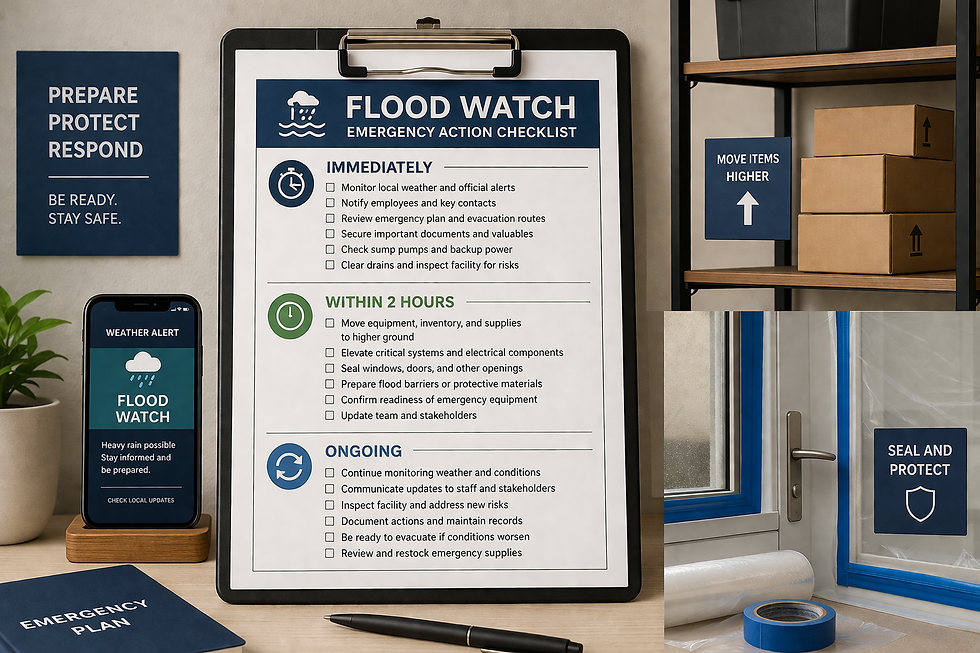
During a Flood Watch: Your Action Checklist
Immediately (within 30 minutes of alert):
[ ] Check forecast for expected rainfall amounts and duration
[ ] Assess current drainage conditions around your building
[ ] Retrieve flood preparation supplies from storage
[ ] Move ground-level inventory to elevated shelving
[ ] Unplug electronics that sit on or near the floor
[ ] Back up any data not already in the cloud
Within 2 hours:
[ ] Apply waterproofing measures to all identified entry points
[ ] Seal basement windows and ground-level vents
[ ] Photograph all sealed areas (documentation for insurance)
[ ] Brief staff on safety protocols and responsibilities
[ ] Position wet/dry vacuum near entrances
[ ] Notify key customers of potential service disruptions
Ongoing during the watch:
[ ] Monitor local emergency management updates
[ ] Check sealed areas every 30 minutes for any breakthrough
[ ] Document conditions with timestamped photos
[ ] Communicate status to customers via your preferred channels
Employee Safety: The Non-Negotiable Priority
No business asset is worth risking human safety. Clear policies protect both your employees and your business:
Establish clear guidelines:
If authorities issue evacuation orders, comply immediately—no exceptions
Employees should never wade through floodwater to reach work (floodwater carries serious health hazards including sewage, chemicals, and debris)
Create a communication tree so everyone knows the plan and their role
Designate who has authority to make closure decisions
During active flooding conditions:
Do not allow customers or employees to enter or exit through actively flooding areas
Electrical hazards in standing water can be fatal
If water is rising inside your building, evacuate rather than attempting to save property
Remote work considerations:
Identify which roles can function remotely
Ensure employees have the tools and access they need to work from home
Communicate clearly about expectations during weather events
Financial Preparation
Emergency fund considerations:
The Small Business Administration recommends maintaining reserves to cover operating expenses during unexpected closures [6]
Consider a business line of credit as a safety net
Understand SBA disaster loan programs before you need them
Documentation for claims:
Maintain current inventory records
Keep receipts for flood preparation expenses
Document all damage with photos and video before cleanup begins
Save all receipts related to cleanup and repairs
Recovery: If Water Gets In
Despite best efforts, some flooding situations overwhelm even good preparation. Quick, informed action minimizes damage and speeds recovery.
Immediate Steps After Water Recedes
Safety first:
Do not enter until authorities confirm the area is safe
Check for structural damage before entering
Be alert for electrical hazards—don't turn on power until an electrician inspects the system
Wear protective equipment (boots, gloves, masks) during cleanup
Documentation before cleanup:
Photograph and video all damage before moving or discarding anything
Make a detailed list of damaged items with estimated values
Contact your insurance company immediately
Cleanup priorities:
Remove standing water as quickly as possible
Begin drying immediately—fans, dehumidifiers, open windows if weather permits
Remove wet materials that can't be dried within 24–48 hours (this helps prevent mold)
Sanitize all surfaces that contacted floodwater
Working with Insurance
File your claim promptly—many policies have time limits
Keep all receipts for cleanup and temporary repairs
Don't discard damaged items until the adjuster has seen them (photograph items if you must remove them for safety)
Understand the difference between repair and replacement coverage
SBA Disaster Loans
The Small Business Administration offers low-interest disaster loans to businesses affected by declared disasters [6]. These can cover:
Physical damage repair
Economic injury (operating expenses during recovery)
Contact your local SBA office or visit sba.gov after a disaster declaration to understand available assistance.
Building Long-Term Resilience
Flood preparedness isn't a one-time project—it's an ongoing aspect of business operations in vulnerable areas.
Infrastructure Improvements to Consider
Backflow valves: Prevent sewage from backing up into your building during floods
Elevated utilities: Moving electrical panels, HVAC equipment, and water heaters above potential flood levels
Improved drainage: Ensuring water flows away from your building, not toward it
Permanent flood barriers: For businesses with recurring risk and resources to invest
Regular Review and Updates
Review your flood plan annually, ideally before your region's flood season
Update inventory documentation quarterly
Test backup systems and communication plans
Train new employees on flood protocols
Replenish supplies as they're used or expire
Community Resources
Connect with your local emergency management office
Join local business associations that share preparedness resources
Understand your community's flood history and patterns
Know your evacuation routes
Prepare Now, Protect Your Business Later
Weather emergencies don't wait for convenient timing. The next flood watch could arrive during your busiest season, your most important project, or the day your key staff member is on vacation.
Being prepared means having supplies on hand before you need them, knowing exactly what steps to take, and having the confidence that your plan will work. It means protecting your physical space while keeping your employees safe and your operations as stable as possible.
The businesses that weather floods successfully share common traits: they understood their risks, they planned ahead, they invested in appropriate protection, and they knew when to prioritize safety over property.
Your next step? Walk through your space this week and identify your vulnerable entry points. Create your checklist. Gather your supplies. When that flood watch notification arrives, you'll be ready to act rather than react.

Frequently Asked Questions
What's the difference between a flood watch and a flood warning?
A flood watch means conditions are favorable for flooding—it's your preparation window, typically issued hours or days in advance. A flood warning means flooding is imminent or already occurring. During a watch, you should execute your preparation plan. During a warning, your focus shifts entirely to safety. Never wait until a warning is issued to begin preparing, as the watch period is when effective action is still possible.
Does standard business insurance cover flood damage?
In most cases, no. Standard commercial property insurance typically excludes flood damage. Flood coverage usually requires a separate policy through the National Flood Insurance Program (NFIP) or a private flood insurer. Review your current policy carefully and consult with your insurance agent to understand your coverage. If you're in a flood-prone area, dedicated flood insurance is essential for business protection.
How quickly can flood preparation measures be deployed?
This depends on your approach. Adhesive barrier products like FloodTape® can be applied to a typical storefront entrance in 15–30 minutes with no special tools. Sandbag deployment typically requires several hours plus the physical effort of filling and placing bags—and that's assuming sandbags are available. The key is having supplies on hand before you need them. Preparation purchased during a flood watch may not arrive in time.
Can my business stay open during a flood watch?
A flood watch alone doesn't require closure—it's a preparation signal. However, if flooding actually occurs, customer and employee safety must take priority. Never allow people to travel through flooded areas to reach your business. Have a clear policy about when and how you'll make closure decisions, and communicate proactively with customers about your status during weather events.
What should I do first when a flood watch is issued for my area?
Check the forecast details for timing and expected severity, then immediately begin your preparation checklist: move vulnerable inventory to elevated positions, apply waterproofing measures to entry points, back up digital data, and communicate with your staff about protocols. The sooner you act during a watch, the more effective your preparation will be.
About This Guide
This guide was developed using flood preparedness best practices from emergency management resources including FEMA and the Small Business Administration, combined with practical experience from business owners in flood-prone regions. The information focuses on actionable steps that small businesses can implement to protect their operations during flood conditions. Always follow local emergency management guidance and prioritize safety over property protection during any flooding event.
Cited Works
[1] Federal Emergency Management Agency — "Flood." https://www.fema.gov/flood
[2] Federal Emergency Management Agency — "Business Continuity Planning." https://www.ready.gov/business-continuity-planning
[3] National Weather Service — "Flood Safety." https://www.weather.gov/safety/flood
[4] FloodTape® — "Product Overview." https://www.myfloodtape.com/
[5] FloodSmart.gov (National Flood Insurance Program) — "Flood Insurance." https://www.floodsmart.gov/
[6] U.S. Small Business Administration — "Disaster Assistance." https://www.sba.gov/funding-programs/disaster-assistance


Comments